
Last updated October 16, 2026
 Wrought iron
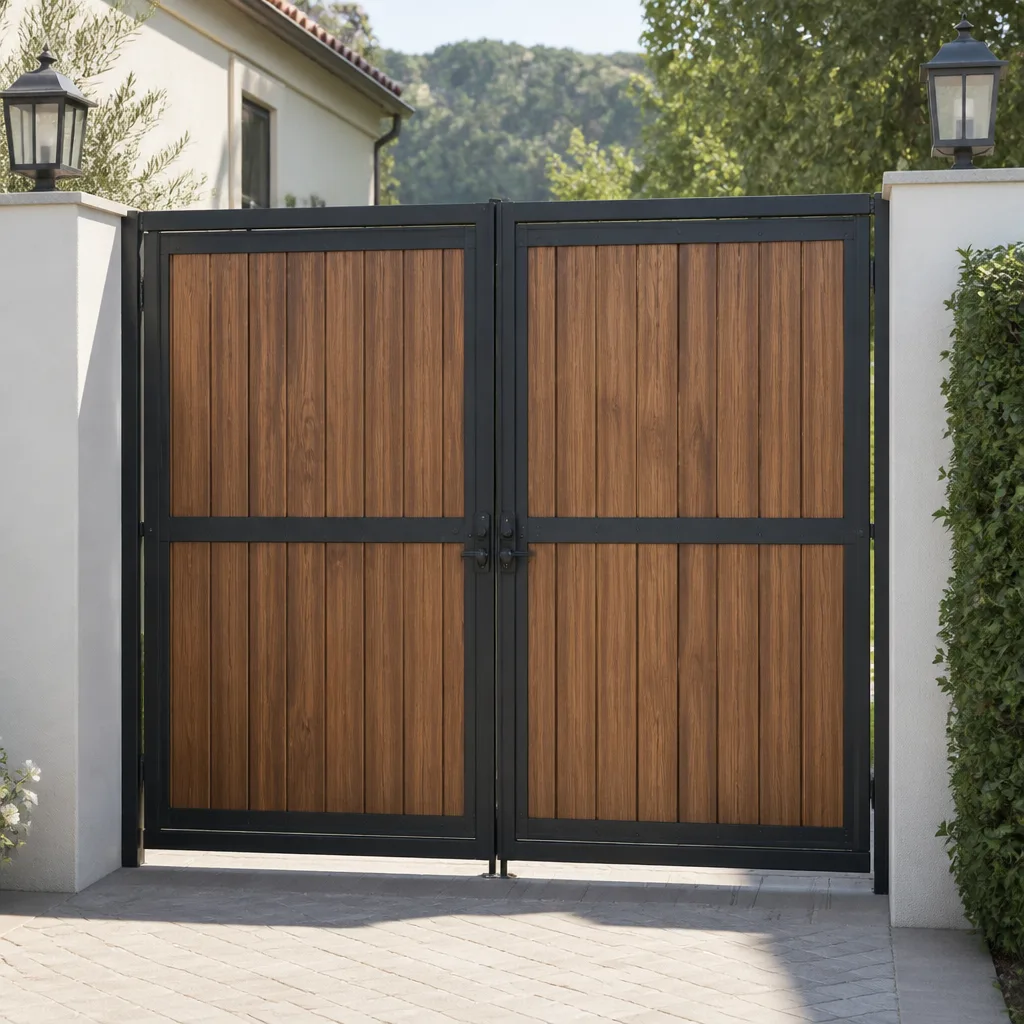 Wood & steel frame
 Farm & ranch
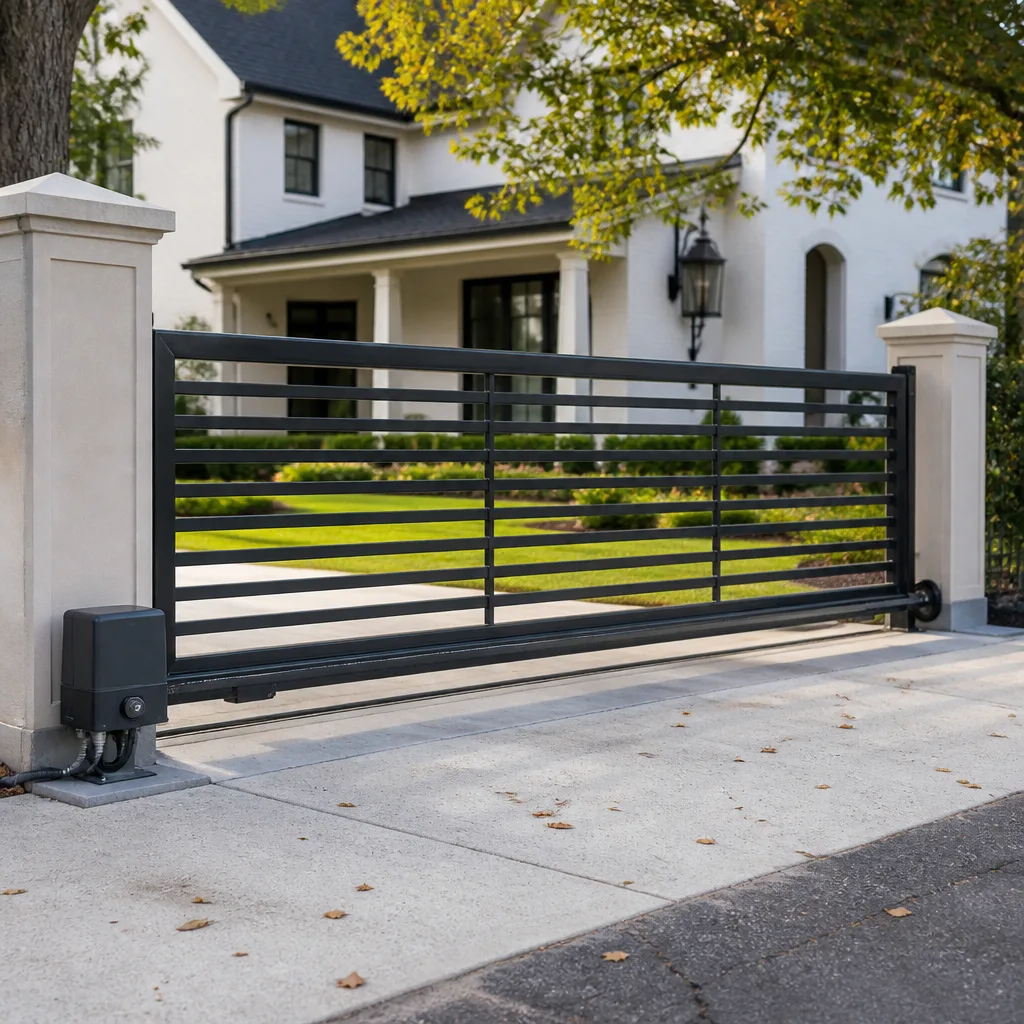 Sliding driveway gates
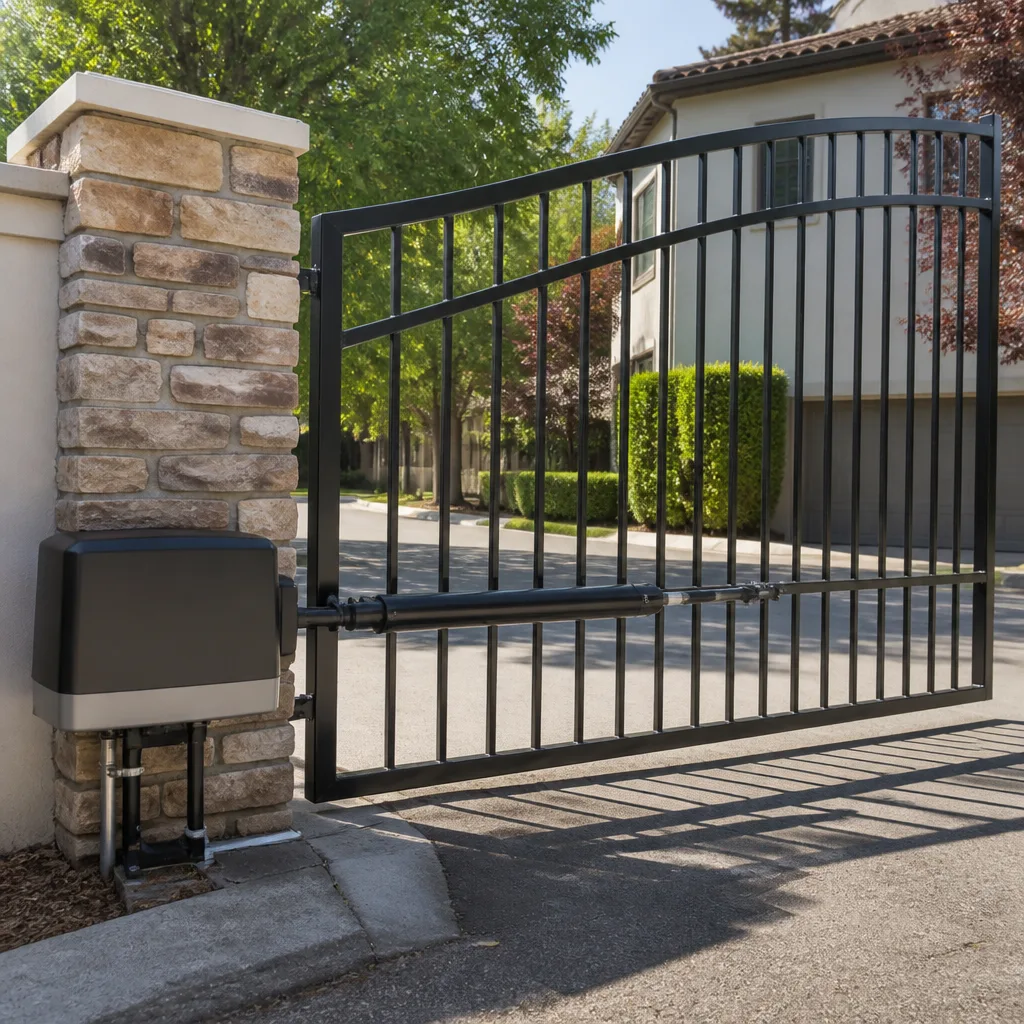 LiftMaster operators
Free on-site gate assessment - hinges, posts, and your LiftMaster or Nice gate operator checked before anything is quoted
The assessment is free and the quote is the invoice.
Get your free estimateGate Repair Maintenance Checklist for West Covina Homeowners
The most destructive thing a West Covina homeowner can do to a gate operator is spray WD-40 on the chain drive. It strips the factory lubricant, attracts dust from the San Gabriel Valley’s dry winds, and accelerates wear on the very components it was meant to protect. But it’s the first thing most people reach for because nobody ever told them otherwise. This guide replaces guesswork with a calibrated checklist built around what actually fails on gates in West Covina. You’ll learn the twelve maintenance items that prevent the three most expensive gate failures locally, when to do each one, and which tasks require a trained hand.
Styles & brands we work with
Quick Answer
A proper gate maintenance routine for West Covina homeowners breaks into three cadences: monthly visual checks of hinges, rollers, and obstruction sensors; quarterly testing of the operator’s force settings and safety reverses; and annual lubrication with system-specific products, plus a full balance check on swing gates. The most critical maintenance item is keeping the gate balanced and the drive components lubricated with the correct product, because an imbalanced gate shortens motor life by years. Skipping these steps turns a $50 maintenance call into a $1,100 operator replacement.
Table of Contents
- Why West Covina’s Climate Demands a Different Checklist
- The Monthly Gate Maintenance Checklist
- The Quarterly Gate Maintenance Checklist
- The Annual Gate Maintenance Checklist
- Lubrication: What to Use, What Never to Substitute
- How to Check Gate Balance Without Tools
- Nylon Roller Wear: What 30% vs. 70% Wear Looks Like
- Common Mistakes to Avoid
- When to Call a Professional
- Frequently Asked Questions
- The Bottom Line
Why West Covina’s Climate Demands a Different Checklist
West Covina sits in the San Gabriel Valley, where summers regularly push past 95 degrees and the Santa Ana winds carry fine, abrasive dust from the foothills. That dust is the difference between a generic gate maintenance checklist and one that works here. In coastal climates, gates fail from moisture and salt corrosion. In West Covina, gates fail from dust accumulation, thermal expansion stress on metal components, and rubber degradation from UV exposure plus heat cycling.
We see three failures repeated across West Covina neighborhoods more than any others. First, dried-out or contaminant-packed drive chains and racks snap or strip. Second, swing gate hinges bind as metal expands in summer heat, transferring stress to the operator motor until it burns out. Third, nylon rollers crack from UV exposure and grind against their tracks, eventually seizing and pulling the gate off-alignment. Each of these is preventable with the right maintenance at the right interval.
A generic checklist might tell you to “lubricate moving parts.” That instruction is worse than useless here. Spray lubricant on a dusty chain creates sludge. The right checklist names the specific product for the specific component, and it accounts for the fact that West Covina’s dry air means lubrication breaks down faster than in humid climates. That’s why the quarterly cadence matters as much as the monthly one. The Gate Repair in West Covina work we do tracks with this pattern: by the time a homeowner calls us, one of these three failures has already started, and the underlying cause was a maintenance gap from months earlier.
The Monthly Gate Maintenance Checklist
Monthly checks take ten minutes and catch failures at the “cheap fix” stage rather than the “replace the operator” stage. Do these on the first weekend of every month, or whenever you hear a new sound from the gate.
- Listen to the gate cycle. Stand next to the operator while the gate opens and closes. A healthy gate makes a low, even whir. A groan, squeal, clicking, or grinding sound means something is binding, dry, or misaligned. Record the sound on your phone and compare it next month. New noise always means new wear.
- Watch the gate movement. The gate should move smoothly from fully open to fully closed with no stutter, pause, or visible wobble. A swing gate should stay in a flat plane as it arcs. A sliding gate that shudders usually has debris in the track or a worn roller.
- Clear the track and rollers. Use a stiff brush or leaf blower to remove dust, leaves, and gravel from the track channel and around the rollers. In West Covina, wind-blown debris collects in gate tracks within days, not weeks. Gravel in the track is a common cause of roller damage.
- Test the obstruction sensor. With the gate closing, wave your hand in front of the photo eye sensor (the small box near the base of the gate post). The gate should stop and reverse immediately. If it does not, stop using the gate and have it serviced. This is a safety device, not a convenience feature.
- Check hinge bolts on swing gates. Grab the gate at the hinge side and pull upward firmly. If there is any vertical play, the hinge bolts are loosening. A loose hinge under a West Covina summer heat load will bind and burn out the operator motor within a season.
These five items prevent roughly 80% of the emergency calls we handle. The remaining 20% get caught by the quarterly and annual items below.
The Quarterly Gate Maintenance Checklist
Quarterly maintenance deals with the mechanical adjustments that drift out of spec gradually. If you only do these four items four times a year, you’ll catch most developing failures before they become emergencies. They also keep your warranty intact, which matters more than most homeowners realize.
- Check and adjust the operator force settings. The force setting controls how hard the motor pushes the gate. If it’s set too high, the gate will keep pushing through an obstruction instead of reversing, which is a safety hazard and a legal liability. If it’s set too low, the gate will trip the obstruction circuit on windy days and stop mid-cycle. Pull the manufacturer’s manual for your specific model (LiftMaster, FAAC, BFT, and Mighty Mule each have their own adjustment procedure) and confirm the force is in the recommended range. If you’re not comfortable doing this, it’s a five-minute job for a technician.
- Test the auto-reverse on both gate panels. A double swing gate has two operators and two reversing circuits. Test each panel independently by applying firm hand pressure against the leading edge while it closes. Both panels should reverse within two seconds of contact. If one panel reverses and the other does not, the second panel’s current sensor is out of adjustment.
- Inspect wire insulation and conduit. Look at every exposed wire between the operator housing and the gate frame. West Covina’s UV exposure degrades insulation faster than most climates; cracked or chalky insulation lets moisture in during the winter rains and causes shorts. If you see cracking, call for a repair before the rainy season, not after.
- Clean and tighten the chain or rack. On chain-drive systems, check the tension by pressing down on the chain midway between sprockets. It should deflect about a quarter of an inch. Too loose and it skips; too tight and it destroys the gearbox. For rack-and-pinion systems, look at the mating teeth between the rack and pinion gear. Worn, pointed, or hooked teeth mean the rack or pinion needs replacement, not just cleaning.
These quarterly items are the ones most likely to void a manufacturer warranty if skipped. LiftMaster and FAAC, for example, both explicitly exclude damage caused by “improper maintenance” or “failure to maintain the operator per the manual.” That’s not a scare tactic; that’s the warranty language. Do the quarterly checks, document them, and keep your claim alive.
The Annual Gate Maintenance Checklist
The annual pass is the one that resets the clock on wear. It’s also the one that requires the most judgment about when to replace parts rather than clean them. Do this once a year, ideally in early fall before the Santa Ana winds arrive, or in early spring before the summer heat stresses every metal component.
- Lubricate every moving component with the correct product. This is covered in depth below, but the short version: use a dry-film lubricant designed for gate components, never WD-40, and never grease on a chain in a dusty environment. Clean the component first, then lubricate, then wipe off excess. Excess lubricant is a dust magnet.
- Apply a UV protectant to nylon rollers and plastic housings. This is a West Covina-specific task. Nylon rollers fail from sun exposure before they fail from mechanical wear. A UV protectant spray adds two to three years of life to rollers in our climate. Apply it every fall.
- Perform the full balance test on swing gates. The no-tools balance test below takes two minutes. Write down your measurements and compare them year over year. A gate that’s drifting out of balance by a quarter inch per year will kill its operator within five years.
- Check the gate’s mounting posts for plumb. Place a level vertically against each gate post. A post that has shifted out of level by more than a quarter inch over its length will transfer uneven load into the hinges and operator. In West Covina, soil movement from the wet-dry cycle of winter rains and summer drought is a real factor; posts creep.
- Document everything. Take dated photos of the chain, rollers, hinges, and operator housing. Keep a simple note on your phone or in a binder. If you ever need a warranty claim or want to show a technician what the gate looked like a year ago, you’ll have the baseline.
If this annual list feels like more than you want to take on, a Gate Motor Repair in West Covina service visit includes most of these checks as part of the inspection. The key is that they happen every year, not that you personally do every item.
Lubrication: What to Use, What Never to Substitute
Lubrication is where the most destructive maintenance mistakes happen. The wrong product causes more damage than no product at all. Here’s the breakdown for the two main drive systems found on gates in West Covina.
Chain drive systems (common on LiftMaster and Mighty Mule sliding gates): The correct product is a dry-film lubricant, specifically a PTFE-based spray or a dedicated chain lubricant made for low-speed drive chains. Apply it lightly to the inside of the chain, rotate the chain by cycling the gate manually or with the motor, and wipe off any excess. The chain should look wet for about five minutes, then dry to the touch with a light film. Never use automotive chain grease or gear oil. In West Covina’s dry, dusty air, grease captures grit within days and turns into a grinding paste that wears out sprockets and chain pins.
Rack-and-pinion systems (common on FAAC, BFT, and commercial-grade gate operators): Rack-and-pinion systems usually need no lubricant at all. The pinion gear runs dry against the rack by design. If you lubricate it, you create a dust-trapping surface that accelerates tooth wear. The correct maintenance is cleaning: brush the rack teeth free of dust and debris every month, and check for hooked or worn tooth profiles quarterly. If you see metal flakes accumulating under the rack, the pinion is wearing and needs replacement, not lubrication.
Hinges and pivot points: Use a silicone-based spray or white lithium grease on swing gate hinges. These points are shielded from direct dust exposure if the hinge design is correct, so a light grease is acceptable. Apply once a year, work the gate back and forth several times, and wipe off what squeezes out.
What to never use: Never use WD-40 or any penetrating oil on any gate drive component. WD-40 is a water displacer and solvent, not a lubricant. It strips away whatever factory lubricant remains, dries quickly, and leaves bare metal that grinds and wears. Never use cooking oil, motor oil, or grease marketed for automotive wheel bearings. Each of these has different viscosity and additive chemistry than gate components are designed for.
If you’re not sure which drive system your gate uses, look at the drive rail. A chain looks like a bicycle chain running in a channel. A rack is a flat steel bar with square teeth cut along one edge. Match the component to the lubricant, not the brand name on the operator.
How to Check Gate Balance Without Tools
An imbalanced swing gate is the silent motor killer. When a gate is properly balanced, the operator only has to overcome inertia and friction, which takes very little force. When a gate sags by even half an inch at the latch end, the operator has to lift that weight through every cycle. That continuous extra load shortens motor life by years, not months.
Here’s how to check balance on a swing gate with no tools in under two minutes:
- Disengage the operator. Every gate operator has a manual release, usually a pull handle or keyed lever on the motor housing. Disengage it so the gate moves freely by hand. On most LiftMaster and FAAC models, this is a red or yellow pull knob that turns a quarter turn. If you can’t find it, check the manual.
- Walk the gate through its arc slowly. Stand at the latch end of the gate and swing it open by hand, paying attention to how the weight feels. A properly balanced gate moves with consistent resistance throughout its arc, no point where it suddenly feels heavier or wants to swing on its own.
- Stop at mid-swing and let go. Position the gate halfway through its arc and release it. A balanced gate will stay roughly where you left it. A gate that swings closed on its own has a weight distribution problem at the hinges or is mounted slightly out of level. A gate that swings open indicates the gate is racked or the hinge pins are worn.
- Lift at the latch end. Grab the gate at the far end from the hinges and try to lift it vertically. Any movement at all means the hinge bushings or bolts have play. Play gets worse quickly, and it changes the balance every week.
If your gate drifts, sags, or has hinge play, have it corrected before running the operator more. Gate Installation in West Covina work we do always starts with correcting the post and hinge geometry, because a gate installed out of balance will eat operators no matter how well you maintain the motor. The balance check is free to do and takes less time than reading this section.
Nylon Roller Wear: What 30% vs. 70% Wear Looks Like
Nylon rollers are the consumable part on sliding gates. They ride in the track channel, carry the full weight of the gate, and wear out faster in West Covina’s UV and dust environment than in most other climates. Knowing when to replace them means you spend $30 on a roller instead of $600 on a track repair or $1,100 on an operator replacement.
Here’s what to look for during your monthly check:
30% wear (healthy, no action needed): The roller surface is smooth and unbroken. There are no visible cracks when you look closely under direct sunlight. The roller spins freely when you reach in and turn it by hand with the gate stationary. There’s no visible flat spot on the circumference. The roller may show light discoloration from dust, but the nylon itself is intact. At this stage, applying the annual UV protectant and keeping the track clean is all you need to do.
70% wear (replace within 30 to 60 days): Small hairline cracks are visible on the roller surface, especially around the axle hole. The roller shows a flat spot where it has been sitting against the track under load. You may see brownish discoloration where the nylon has oxidized. The roller may still spin, but it feels rough or catches partway through its rotation. At this stage, the gate already makes more noise than it did new, and you may notice it vibrating slightly as it travels. Order a replacement roller now and schedule the swap at your convenience. Ignoring a 70%-worn roller turns it into a seized roller within months.
There’s no 100% sign, because at that point the roller has likely seized and is no longer rolling; it’s being dragged along the track. You’ll see deep gouges worn into the roller, chunks of nylon missing, and corresponding scratches carved into the track. A seized roller drags the gate’s frame out of alignment, and that pulls the operator’s gearbox into failure mode. When a roller seizes, stop using the gate until it’s replaced.
If you’re not sure what you’re looking at, photograph the roller at close range and send the photo to a gate service for a second opinion. The Carver Gate Repair West Covina home team handles these calls regularly and will tell you honestly whether the part can wait, because the written price and the honest answer are part of the same standard.
Common Mistakes to Avoid
- Spraying WD-40 on the chain or rack. As covered above, this is the single most damaging action a West Covina homeowner performs on a gate. It strips protection and creates a dust-collecting surface. The correct product is a dry-film PTFE lubricant, and only on chain systems.
- Adjusting the force setting to “fix” a slow gate. When a gate slows down, the problem is mechanical drag, not the force adjustment. Cranking up the force setting to compensate will burn out the motor and create a dangerous situation where the gate is strong enough to crush something before reversing. The force setting has a max for a reason.
- Skipping the obstruction sensor test after landscaping work. Hedges and plantings grow over the sensor eye slowly, and a leaf blower can knock the alignment off. The gate still opens and closes, so the homeowner doesn’t notice the sensor is dead until something gets hit. Test it monthly, and especially after any yard work near the gate.
- Waiting until a sound becomes loud to investigate it. New gate sounds are early warnings. A click today is a broken gear in six months. The earlier you address a sound, the cheaper the fix. Recording gate sounds with your phone helps you catch new noise early.
- Lubricating a dirty chain. Lubricant over dust creates abrasive slurry. Always brush the chain clean before applying lubricant, or you’re just accelerating the wear you think you’re preventing.
- Doing electrical work on the operator while it’s powered. Even low-voltage gate operators store enough charge in their capacitors to give a painful shock. Always disconnect power and discharge per the manual before opening the operator housing. If you’re unsure, this is technician territory.
- Installing a universal remote without confirming compatibility. LiftMaster, FAAC, and Mighty Mule each use different receiver protocols. A universal remote that “worked at the old house” may not pair with the operator you have now. Check the receiver’s brand and frequency before buying a replacement remote.
When to Call a Professional
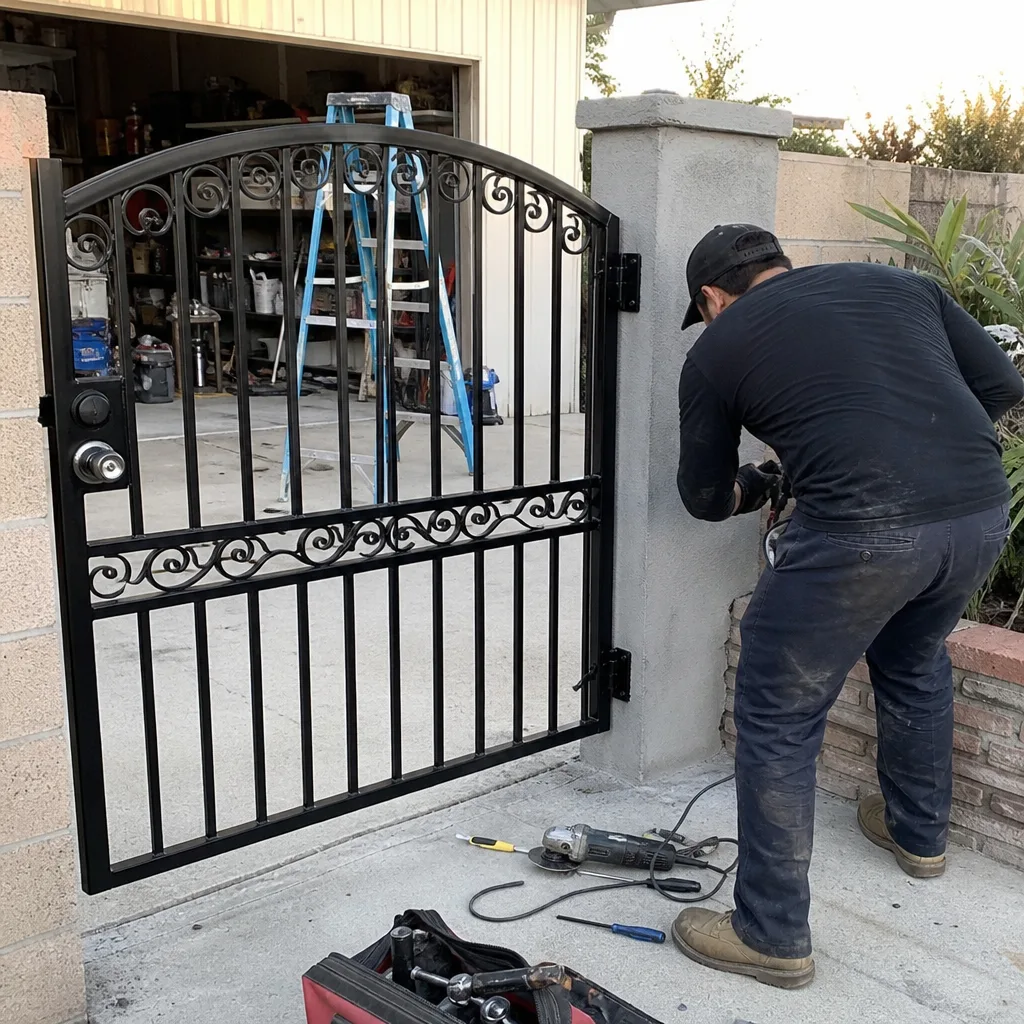
Several maintenance items are genuinely dangerous to attempt without training. Gate operators contain heavy springs, capacitors that hold charge, and motors that can apply hundreds of pounds of force. If your gate makes a grinding sound, trips a breaker repeatedly, moves in a jerky motion, or fails the obstruction sensor test, stop using it and call a technician. The same applies to any hinge or bracket replacement on a heavy gate; a gate weighing 400 pounds under spring tension is not a DIY project. Gate Repair from Carver Gate Repair West Covina offers free estimates in West Covina, with a written price before any work starts, so you always know the number up front. Call (925) 268-7956 to schedule a visit or get a second opinion on a wear issue.
Frequently Asked Questions
Monthly visual checks and sensor tests, quarterly mechanical adjustments, and a full annual service are the correct cadence for West Covina’s dust and UV environment. Monthly tasks take ten minutes, quarterly tasks take 30 minutes, and the annual pass takes about an hour. Call (925) 268-7956 if you’d rather have a technician handle the quarterly and annual work; estimates are free.
The most common cause is dust accumulation on drive components combined with a wrong or skipped lubrication routine. Dust gets into chains and racks, the lubricant breaks down or was the wrong product from the start, and the added friction overloads the operator motor. This failure pattern repeats across every West Covina neighborhood we serve.
No. WD-40 is a solvent and water displacer, not a lubricant. It strips the factory lubricant from chain pins, dries quickly, and leaves bare metal exposed to West Covina’s abrasive dust. Use a PTFE-based dry-film lubricant made for drive chains instead. Call (925) 268-7956 for a free recommendation specific to your gate’s drive type.
Minor gate repairs in West Covina, such as roller replacement or sensor realignment, typically run from $150 to $350, while motor replacements range from $650 to $1,200 depending on the brand and drive type. Before any major work, check Gate Repair Permits, Codes & Inspections in CA: What You Need to Know to stay compliant. Large gate track repairs or hinge reconstruction can reach $1,500. Every repair starts with a written price before work begins, so the number never moves once the job is open. Call (925) 268-7956 for an exact quote.
A full maintenance service includes cleaning the track and drive components, checking and adjusting force settings, testing both safety reverse circuits, lubricating the correct components with the correct products, checking balance and hinge wear, and inspecting wire insulation. Each item is documented with photos, so you have a record for warranty purposes and future comparison. Call (925) 268-7956 to schedule maintenance or get a written price.
Yes. Our technicians are trained on LiftMaster, FAAC, BFT, and Mighty Mule systems, among others, so the right parts and the right diagnostic approach are matched to the equipment already installed on your gate. We carry common parts for these brands and can source the rest quickly. Call (925) 268-7956 with your model number for service or parts questions.
The Bottom Line
Gate maintenance in West Covina is not about doing more; it’s about doing the right things at the right intervals. Monthly checks catch debris and sensor problems before they become mechanical damage. Quarterly adjustments keep force settings and safety circuits honest. Annual lubrication, balance checks, and UV protection reset the wear clock. The difference between a gate that lasts twenty years and one that kills its operator in five is almost always maintenance, not equipment quality. If you prefer to spend your time on something other than gate upkeep, Carver Gate Repair West Covina handles every item on this checklist, with written prices and a full-year guarantee on every repair. Explore our more guides & resources for additional home maintenance help. Call (925) 268-7956 to schedule a visit.
Written by Lonnie Burke, Owner at Carver Gate Repair West Covina, serving West Covina since 2008.
See the difference
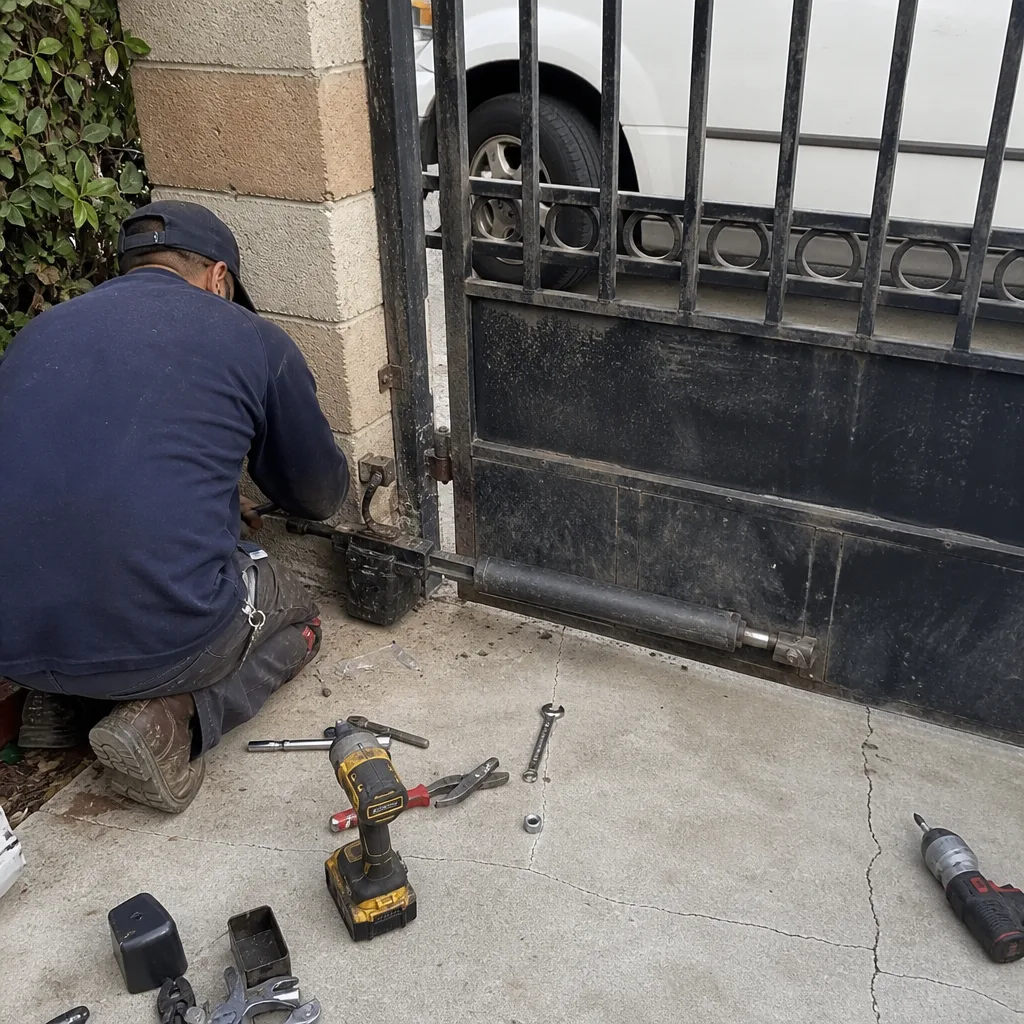 Before
 After
After Before
 After
After Before
 After
After