
Last updated October 16, 2026
 Wrought iron
 Wood & steel frame
 Farm & ranch
 Sliding driveway gates
 LiftMaster operators
Free on-site gate assessment - hinges, posts, and your LiftMaster or Nice gate operator checked before anything is quoted
The assessment is free and the quote is the invoice.
Get your free estimateDIY vs Professional Gate Repair: The West Covina Homeowner’s Decision Guide
California’s UL 325 safety standard exists because automated gates have killed people. A gate that rolls smooth and quiet can still crush a child, a pet, or an adult if the entrapment protection was wired incorrectly. That’s the uncomfortable truth most DIY gate repair guides skip. This guide draws the line at the task level: here’s exactly what a competent West Covina homeowner can handle with basic tools, what requires a licensed contractor by law, and where the break-even point sits between your weekend labor and a pro who does this every day. You’ll leave knowing which repairs are genuinely yours and which ones put your family and your liability on the line.
Quick Answer
Mechanical maintenance like lubrication, track cleaning, remote battery replacement, and visible hardware tightening are reasonable DIY tasks for a West Covina homeowner. Anything involving motor wiring, control boards, limit switch calibration, or structural gate components should go to a licensed professional, both for safety under California’s UL 325 entrapment protection requirements and because a miswired motor system voids manufacturer warranties and can create liability you personally carry. The cost break-even for most repairs lands around $180 to $300 in parts, after which professional our Gate Repair services costs the same or less than a DIY attempt once you factor in tools, time, and the cost of correcting mistakes.
Styles & brands we work with
Table of Contents
- What You Can Safely Handle Yourself
- What the Law Says: California’s Contractors License Requirement
- Warranty and Liability: What a DIY Mistake Actually Costs
- UL 325 and Entrapment Protection: The Non-Negotiable
- The Break-Even Analysis: When Professional Service Pays for Itself
- Motor Repair and Replacement: The Hard Line
- Common Mistakes to Avoid
- When to Call a Professional
What You Can Safely Handle Yourself
Not every gate problem needs a service call. Some tasks are routine maintenance that manufacturers expect homeowners to perform, and doing them yourself extends the life of your gate and catches small issues before they become expensive failures. These are the tasks we tell West Covina homeowners to own, no phone call necessary.
The key distinction is this: if the task involves moving parts you can see, lubricants you can buy at any hardware store, and no wiring, you’re in safe DIY territory. If the task requires opening a control box, splicing a wire, or removing a motor housing, stop there. The line is visible, and crossing it changes the legal and safety picture entirely.
Lubrication
Gate hinges, wheels, chains, and tracks need lubrication every six months in West Covina’s dry, dusty climate. The airborne dust from the San Gabriel Valley settles into gate tracks faster than in coastal cities, and it mixes with old grease to form a gritty paste that accelerates wear. Use a silicone-based lubricant on rollers and wheels, a lithium grease on chains, and avoid WD-40, which displaces grease rather than replacing it. This is a 20-minute task that can save you a $300 track replacement later.
Track and Debris Clearing
Sliding gate tracks collect leaves, gravel, and dirt, especially during West Covina’s Santa Ana wind season. Clear the track with a stiff brush or a shop vacuum, and check for small stones lodged in the guide wheels. A pebble the size of a dime can cause a gate to bind and chatter, and over time that vibration loosens the bolts that hold the whole assembly square. Clearing the track monthly is the single highest-return DIY task on any sliding gate system.
Remote Battery and Keypad Maintenance
Remote transmitter batteries die on their own schedule. Replacing them takes a screwdriver, a CR2032 or A23 battery depending on the remote, and 90 seconds. Keypad failure is often just corrosion on the contact points, clean them with a fine-grit sandpaper or electrical contact cleaner before replacing the unit. These are $5 to $15 tasks, and no reasonable homeowner should pay a service fee for them.
Visible Hardware Tightening
Gate hinges, post brackets, and wheel bolts vibrate loose over time. A monthly visual check with a wrench catches loose hardware before a hinge tears out of the post or a wheel comes off its axle. This is inspection and tightening only, not hinge replacement or post repair, which require different skills and are addressed later in this guide.
For everything in this section, the tools are basic, the parts are inexpensive, and the consequence of a mistake is minimal. That’s the standard. If you wouldn’t let your teenager do it unsupervised, it probably belongs in the professional category.
What the Law Says: California’s Contractors License Requirement
California law, not homeowner preference, defines the boundary on gate work. The Contractors State License Board classifies automated gate installation and repair under the C-61/D28 specialty license, which is specifically for “gates and automatic gate systems.” Any work on a gate operator, motor, control board, or the structural movement of a gate over $500 in total project value requires a licensed contractor. That means the law, not just best practice, excludes a homeowner without that license from performing significant gate repair work on a compensated basis, and it also signals which tasks the state considers beyond casual DIY scope.
The relevant distinction for a West Covina homeowner is this: the state’s licensing requirement attaches to the scope of work, not to who performs it. A neighbor can’t legally charge you to rewire a gate motor without a C-61/D28 license. More importantly, if an unlicensed repair creates a hazardous condition and someone is injured, the liability can fall on you as the property owner, because you authorized unlicensed work on a regulated system.
What does the C-61/D28 scope include in practice?
- Gate operator installation and replacement, including LiftMaster, DoorKing, Elite, and Mighty Mule systems
- Motor control board diagnosis and replacement
- Safety sensor installation, alignment, and wiring
- Limit switch adjustment and replacement on automated systems
- Gate fabrication and structural repair above basic hardware replacement
- Photo eye and edge sensor integration
This list aligns with the natural boundary of what’s safe to DIY. The state doesn’t license lubrication or track cleaning, because those tasks don’t create entrapment risk. The state does license anything that touches the automation system, because automation failures are what injure people. When a West Covina homeowner asks us whether a specific task is DIY-appropriate, the first question we ask is whether the task requires touching a wire or a structural weld. If yes, the license line applies.
If you’re weighing DIY against hiring, see our full breakdown of what professional gate repair in West Covina actually includes, task by task.
Warranty and Liability: What a DIY Mistake Actually Costs
Manufacturer warranties on gate motors and control boards are conditional documents. LiftMaster, DoorKing, Elite, and Mighty Mule all include warranty language that voids coverage for “unauthorized modification, improper installation, or repair by unqualified persons.” A homeowner who opens a control board, misidentifies a terminal, and fries a $400 board has not just paid for the board, they’ve ended the warranty on a $1,200 motor that the board controls. The real cost of that mistake isn’t the board, it’s the loss of future coverage on the entire system.
In our experience, the most common DIY failure that voids warranties is incorrect wiring of the reverse polarity on DC motors. Homeowners see two wires, switch them, and the gate runs in reverse until it hits the stop and strips the gear. The motor still powers on, so the gate appears functional, but the gearbox is now damaged and the manufacturer will reject a warranty claim because the wiring shows evidence of unauthorized modification. A technician trained on gate motor repair reads the wire diagram first, not the wire colors, because colors are not standardized across brands.
Liability works differently than warranty. If you modify an automated gate and someone, a delivery driver, a mail carrier, a neighborhood kid, is injured by that gate, your homeowner’s insurance may deny the claim. Insurance policies require that regulated systems be maintained to code, and a homeowner-modified gate operator that doesn’t meet UL 325 entrapment protection requirements is not code-compliant. You would then be personally liable for medical costs, lost wages, and legal defense. That number starts in the tens of thousands and climbs from there.
The math on a $40 DIY limit switch adjustment looks different when the downside is a denied insurance claim. That’s the warranty and liability frame in one sentence.
UL 325 and Entrapment Protection: The Non-Negotiable
UL 325 is the Underwriters Laboratories standard that governs automatic gate operator safety. It was written because automated gates have killed people, including children, and it mandates specific entrapment protection measures on every automated gate system installed or modified in the United States. The standard is not a suggestion. It is enforceable through building codes, insurance requirements, and in the worst cases, wrongful death litigation.
An automated gate system must include two independent means of entrapment protection. That typically means a combination of photo eyes, which detect an obstruction in the gate’s path, and an edge sensor, which detects physical contact with the gate itself. These devices must be wired so that if either one fails, the gate reverses or stops. The wiring logic that makes this work is not obvious, and a homeowner who connects a sensor incorrectly can create a condition where the gate passes a visual inspection but will not reverse when it contacts an obstruction.
Here’s the specific scenario we’ve seen in West Covina. A homeowner installs a new gate motor, connects the photo eyes but reverses the common and normally-closed wires on the edge sensor. The gate opens and closes fine. The photo eyes work. The edge sensor never functions because it’s wired as a dead switch. Six months later, a child leans into the gate’s path, the gate closes, and the edge sensor doesn’t trigger. The gate was modified by an unqualified person, the entrapment protection was compromised, and the homeowner bears the liability. A trained technician checks each safety device independently, with a test block and a meter, before declaring the system safe. That’s the difference between installation and verification.
UL 325 also sets gate force limits. An operator must reverse when it encounters a certain resistance level, and that level is set with a force gauge, not by feel. A homeowner who sets the force too high by cranking the adjustment screw “until it works” has created a gate that will not reverse until it has already caused injury. California’s climate doesn’t change UL 325, but West Covina’s hillside homes, with steep driveway grades, do affect force settings, and an accurate installation requires accounting for slope load. That’s a professional calculation, not a guess.
Any DIY guide that tells you to install or rewire a gate operator without addressing UL 325 is leaving out the single most important safety consideration on the page.
The Break-Even Analysis: When Professional Service Pays for Itself
The honest math on DIY versus professional gate repair starts with what you’re actually paying for. DIY is never free. You’re paying for parts, tools you may not own, and your own time at whatever you value it at. The break-even point is the repair dollar amount where professional service costs the same or less than doing it yourself once all factors are counted.
Here’s a practical table for common gate repairs in West Covina, comparing typical DIY costs to professional pricing.
- Remote battery replacement: DIY $5-$15. Professional $65-$95 service call. Verdict: DIY always wins.
- Track cleaning and lubrication: DIY $10-$20 in materials. Professional $75-$120. Verdict: DIY wins, this is routine maintenance.
- Hinge bolt tightening: DIY $0 if you own a wrench. Professional $85-$125 service call. Verdict: DIY wins, but only if the bolts are still structurally sound.
- Limit switch adjustment on a swing gate: DIY $0-$30 in parts if it’s a simple mechanical switch. Professional $120-$180. Verdict: DIY can win, but only on certain brands and only if you know exactly which switch does what.
- Control board replacement: DIY $200-$450 for the board, plus $50-$150 for the tools you don’t own, plus 4 to 8 hours of diagnosis and installation. Professional $450-$800 complete. Verdict: Professional wins when you count time and warranty.
- Gate motor replacement: DIY $350-$1,200 for the motor, plus $100-$300 for mounting hardware, safety sensors, and any wiring supplies, plus a full day or weekend. Professional $1,400-$2,600 installed and verified. Verdict: Professional wins on warranty, UL 325 compliance, and time.
- Track replacement on a sliding gate: DIY $150-$400 in track and hardware, plus concrete work if the base is scored. Professional $600-$1,200. Verdict: Professional wins, the concrete work and alignment tolerance is unforgiving.
The break-even lands around $180 to $300 in parts. Below that number, a competent DIYer with the right tools saves meaningful money. Above it, the cost of tools, the time investment, the warranty loss, and the risk of a botched job that needs a professional to correct all push the math toward hiring a licensed contractor the first time.
There’s also the second-visit factor. When a DIY job goes wrong, the professional doesn’t just fix the original problem, they have to undo your work first. That correction labor can cost more than the original repair would have. We’ve billed $400 to unfix a homeowner’s attempt at a $250 fix, and the homeowner paid $650 total for a repair that would have cost $250 if we’d done it first. That’s not a rare outcome.
Motor Repair and Replacement: The Hard Line
Gate motors are the line where DIY crosses into professional territory with no exceptions. The reasons are multiplicative, not additive: the electrical shock risk from capacitor discharge, the UL 325 entrapment requirements, the brand-specific wiring configurations across LiftMaster, DoorKing, Elite, and Mighty Mule, the warranty conditions, and the liability if the system fails to reverse when it matters. Any one of those reasons alone justifies professional installation. Together, they make DIY motor work indefensible.
The specific tasks that fall into this category include replacing a swing arm operator, retrofitting a sliding gate operator, replacing a capacitor or a run transformer, and any work inside the control box that touches the terminal strip. A capacitor holds a charge even after power is disconnected, and it will discharge into your hand if you don’t drain it properly. That’s not a gate repair skill, that’s an electrical safety skill, and it’s the first thing our technicians learn.
The brand complication is real. A LiftMaster LA400 swing operator wires differently than a DoorKing 9150. An Elite SL3000 uses different limit logic than a Mighty Mule MM571W. A homeowner who watches a YouTube video for one model and applies it to another is working without documentation, and the failure modes are unpredictable. When our technicians arrive in West Covina, they know which of the nine gate motor brands they service is installed before they open the control box, and they have the correct wiring diagram loaded on a tablet before they touch a terminal. That’s not a difference in work ethic, it’s a difference in information, and information is the whole job on a motor replacement.
For homeowners planning a full gate replacement rather than a repair, the gate installation in West Covina page explains what a from-scratch build involves, including the concrete work, the hinge layout, and the operator selection.
Common Mistakes to Avoid
- Using WD-40 on gate chains and tracks. WD-40 is a penetrating fluid and solvent, not a lubricant. It strips grease and leaves metal surfaces drier than they started. Use a silicone spray on tracks and lithium grease on chains.
- Adjusting limit switches by trial and error. A limit switch that’s off by a quarter inch changes how far the gate travels, and an over-travel condition slams the gate into its stop or tears the operator bracket. If you don’t know which direction is open and which is close, you’re guessing.
- Ignoring gate force settings after any adjustment. If you change anything in the operator, the force setting changes with it. A gate that reverses too easily won’t close fully, and a gate that doesn’t reverse is a UL 325 violation. This needs a force gauge, not a gut feel.
- Wiring safety sensors in series when they should be in parallel. Photo eyes and edge sensors use different wiring configurations. A series-wired system fails entirely when one sensor fails, and a parallel-wired system can mask a failed sensor. Either mistake creates a dangerous gate that looks fine.
- Replacing a motor without checking the existing mounting bracket. West Covina’s hillside lots put uneven stress on mounting brackets, and a bracket that held an old motor for 15 years may fail under a new motor’s vibration profile. The bracket is part of the replacement, not a separate optional step.
- Pouring new concrete without checking the existing slab depth. Sliding gate tracks in West Covina are sometimes poured over original 1960s slabs that have thinned over decades. A new track on a failed base is a repair you’ll do twice.
- Buying a universal remote before confirming frequency compatibility. Gate remotes use different frequencies, and “universal” means common, not all. A $30 universal remote that doesn’t pair with your DoorKing receiver is a $30 paperweight.
When to Call a Professional
Call a professional when the task touches a wire, a control board, a motor, a structural weld, or a safety device. Call when the gate shudders, grinds, reverses unpredictably, or stops responding to remotes and keypads. Call when a gate hits a car, a child, or a delivery person, and the entrapment protection didn’t trigger. Call when you’ve already tried the DIY fix and the problem persists, because you’re now paying for correction on top of repair. Call when the warranty matters to you, because your participation in the repair ends the warranty. For additional guidance, see more guides & resources on our blog. Carver Gate Repair West Covina offers free estimates in West Covina, call (925) 268-7956 and a live person answers, 24/7, no voicemail queue and no callback later.
See the difference
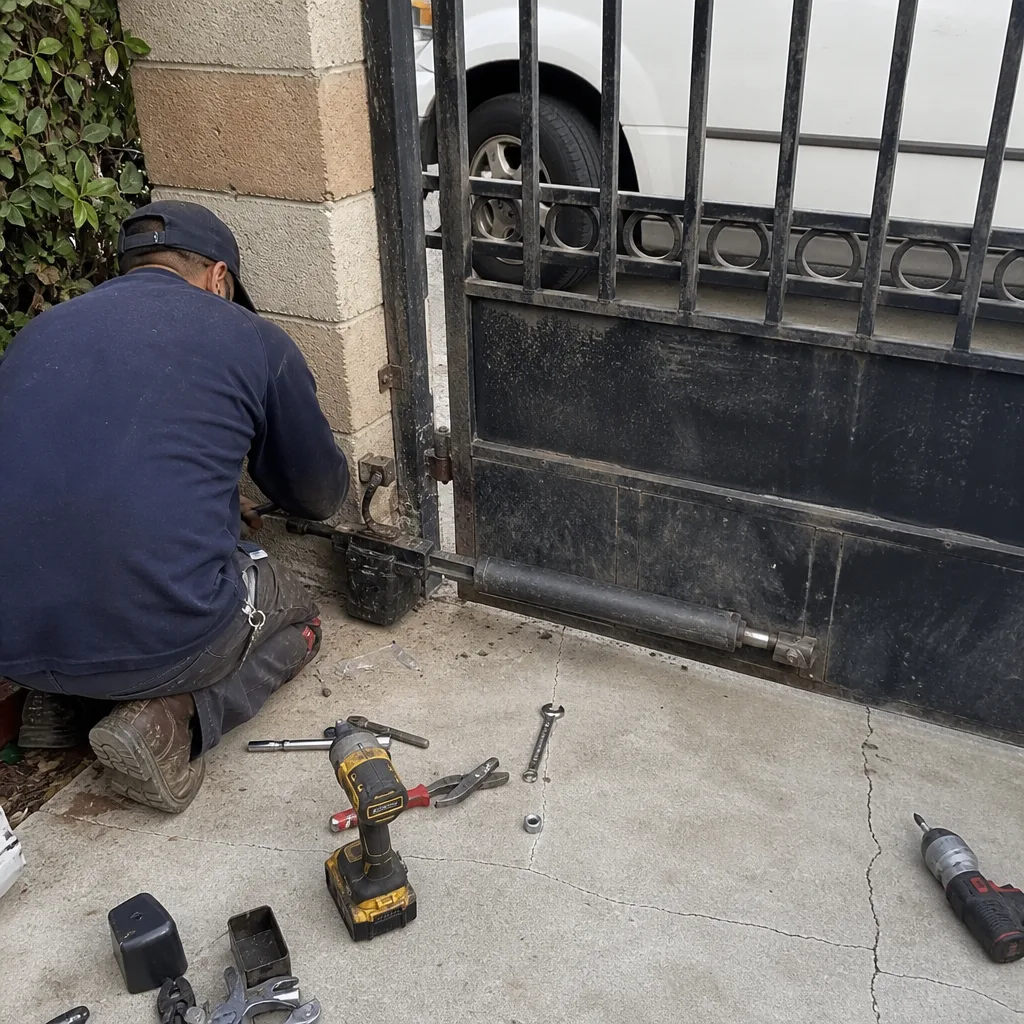 Before
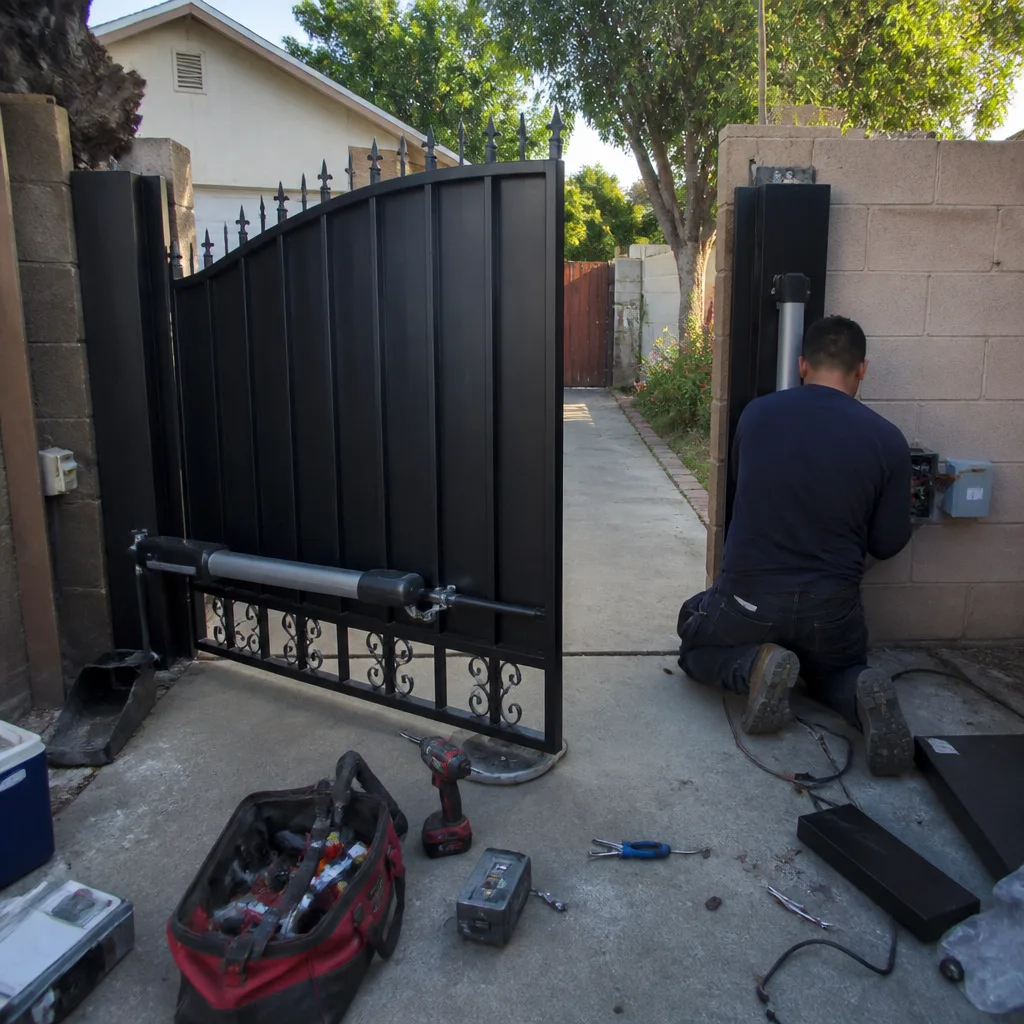 After
After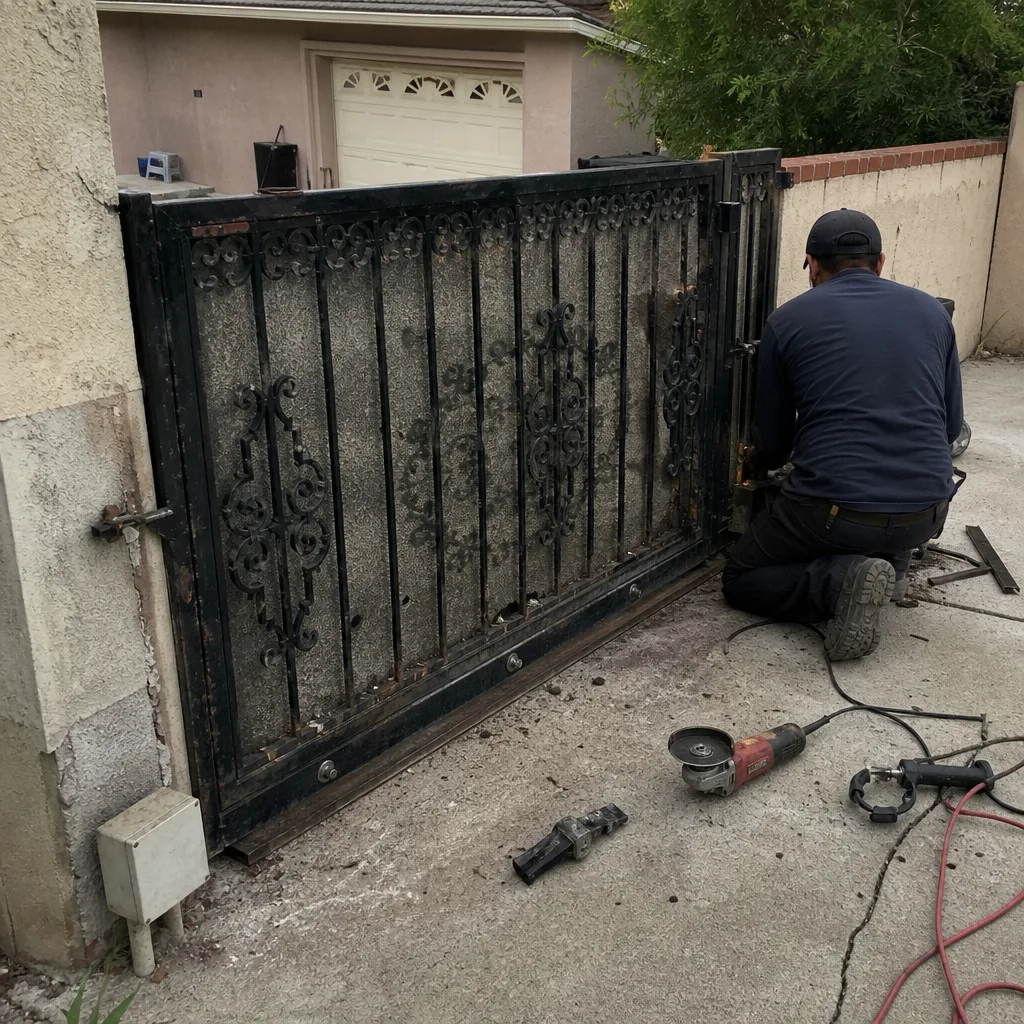 Before
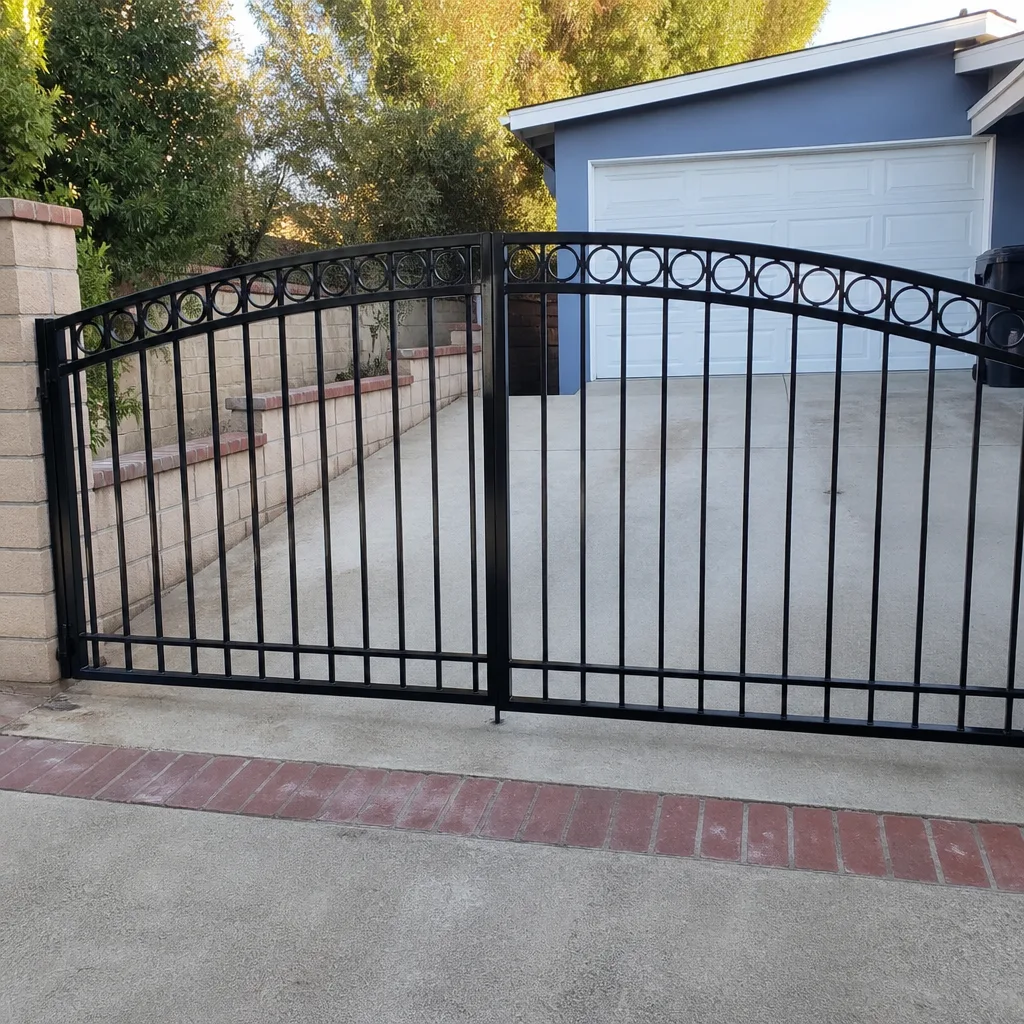 After
After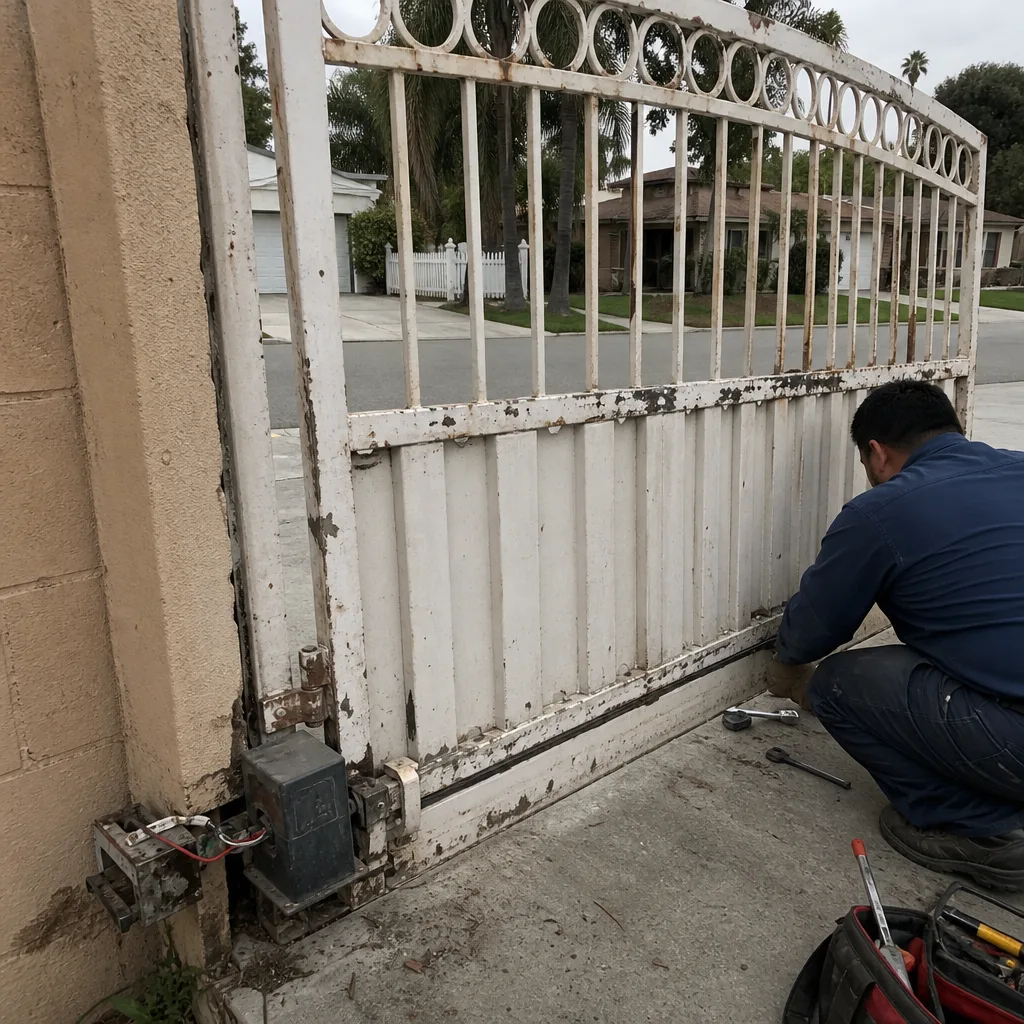 Before
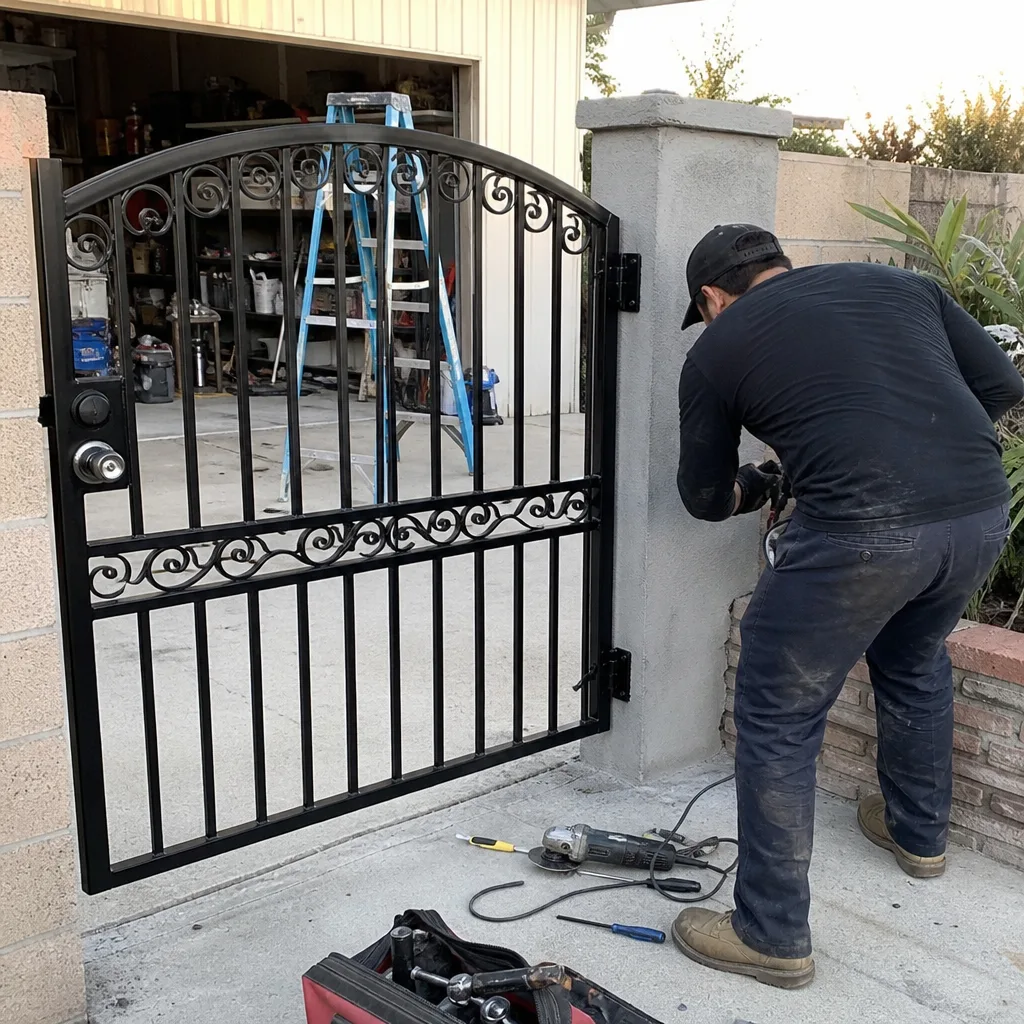 After
AfterFrequently Asked Questions
You can, legally, if it’s your own home, but you shouldn’t. A gate motor replacement requires capacitor discharge safety, UL 325 entrapment protection wiring, brand-specific configuration across LiftMaster, DoorKing, Elite, or Mighty Mule, and accurate force setting. A mistake voids the manufacturer warranty and creates personal liability. Call (925) 268-7956 for a written price before any work starts, and you’ll know exactly what a professional replacement costs before you decide.
Gate repair costs in West Covina typically range from $85 for a simple service call to $2,600 for a full motor and operator replacement. Remote batteries and track cleaning stay under $100, limit switch adjustments run $120-$180, control boards run $450-$800, and track replacements run $600-$1,200. The price is quoted and agreed in writing before any work starts, so the number never moves at the door.
Yes, in most cases. LiftMaster, DoorKing, Elite, and Mighty Mule all include warranty language that voids coverage for unauthorized modification or repair by unqualified persons. If you open a control board and brick it, you’ve also ended the warranty on the motor that board controls. The repair cost just became the parts cost plus the lost coverage.
UL 325 is the safety standard that governs automatic gate operator entrapment protection, requiring two independent safety devices and specific force limits. A gate that doesn’t meet UL 325 can injure or kill someone, and a homeowner who modifies a gate operator and creates a non-compliant condition can be personally liable. This is the single reason gate operator work belongs with a licensed professional.
Yes. Our phones are answered by a live person 24 hours a day, 7 days a week, including weekends and holidays. If you have a gate that won’t open, won’t close, or poses a safety risk, call (925) 268-7956 and we’ll get a technician to your West Covina home today.
Our technicians are trained on nine gate motor brands, including LiftMaster, DoorKing, Elite, and Mighty Mule. That matters because each brand wires differently, and the right parts and the right wiring diagram are the difference between a repair that lasts and a repair that fails in six months. We match the technician to the system you already have installed.
The Bottom Line
Gate repair splits cleanly into two categories. Maintenance tasks you can see, touch, and perform with basic tools are yours to handle, and doing them on schedule keeps your gate running longer and cheaper. Wiring, motors, control boards, and structural work are professional territory, not because homeowners lack intelligence, but because the consequences of a mistake include warranty loss, denied insurance claims, and in the worst cases, the kind of injury UL 325 was written to prevent. The break-even math favors DIY below $300 in parts and professional service above it. When the decision tips professional, call (925) 268-7956 for a written price and a technician who shows up background-checked, uniformed, and ready to work. If you’re still weighing options, the Carver Gate Repair West Covina home page covers the full scope of what we do.
Written by Lonnie Burke, Owner at Carver Gate Repair West Covina, serving West Covina since 2008.